How to Read a BaZi Chart
One chart, read step by step. Follow a fictional New York birth from its eight characters to its Day Master, Ten Gods and ten-year Luck Pillars.
Start with the Day Master, the top character of the Day pillar. Then read the other characters in relation to it, check the season of birth, and look at the ten-year cycles separately. The worked example below shows what each step tells you and where a beginner's reading should stop.
BaZi is a traditional Chinese interpretive system. This tutorial teaches its vocabulary and chart structure; a chart does not establish facts about someone's personality or predict events.
The example chart and its settings
Our fictional person was born on February 4, 2000, at 10:00 am in New York City. We use true solar time, the 23:00 day boundary and Female for the traditional Luck Pillar calculation. New York was on UTC−5; the corrected solar time is approximately 09:50.
Open the BaZi calculator and select “Try an example: born in New York, Feb 4, 2000” to calculate this chart. Use true solar time and the 23:00 day boundary if you previously changed those settings. You can also follow the entire lesson from the diagram and tables here.
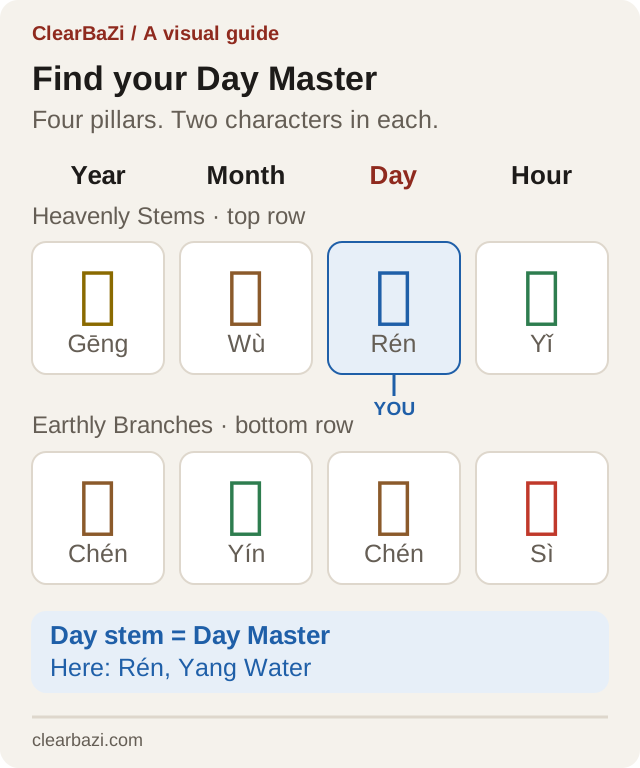
Open the full-size diagram
This birth is just after the Start of Spring in New York. That matters: BaZi changes its Year and Month pillars at solar-term boundaries, rather than at January 1 or Chinese New Year. Another calculator may show a different year if it compares the New York clock directly with a Beijing solar-term time. See the New York comparison case and our calculation method.
Separate the four pillars into stems and branches
Each column contains two characters: a Heavenly Stem above an Earthly Branch. Four pairs make the “eight characters” that give BaZi its name. The animal belongs to the branch, so a Dragon year describes only one of the eight positions.
| Pillar | Top: stem | Bottom: branch |
|---|---|---|
| Year | 庚 Gēng · Yang Metal | 辰 Chén · Dragon · Earth |
| Month | 戊 Wù · Yang Earth | 寅 Yín · Tiger · Wood |
| Day | 壬 Rén · Yang Water · Day Master | 辰 Chén · Dragon · Earth |
| Hour | 乙 Yǐ · Yin Wood | 巳 Sì · Snake · Fire |
What you can read now: the Day pillar is Rén Chén. Rén is the Day Master; Chén is the branch beneath it. “Dragon” is not the Day Master, even though the Day branch happens to be a Dragon too.
Find the Day Master: Rén, Yang Water
The Day Master is the reference point for the rest of the chart. Here it is 壬 Rén, Yang Water, marked “You” in the calculator. Every Ten God label is calculated relative to this stem.
Traditional descriptions compare Rén Water with a river or ocean and use that image to discuss movement and adaptability. Treat that as symbolic language. A Rén label alone cannot tell you how a person behaves: the season, other stems and branches still need to be considered.
Try it on your own chart: find the Day column and copy only its top character. Then use the Day Master overview to look it up. For this example, the relevant page is Rén Water.
Read the Ten Gods as relationships
The Ten Gods are ten relationship labels, not ten deities in the chart. They describe how a stem's element and yin or yang polarity relate to the Day Master. The five broad relationships are peers, output, wealth, power and resource; polarity divides each into two roles.
For a Water Day Master, Metal generates Water (resource), Water generates Wood (output), Water controls Fire (wealth), and Earth controls Water (power). Another Water stem is a peer. Changing the Day Master changes these labels.
| Position | Relationship to Rén Water | Label |
|---|---|---|
| Year: Gēng Metal | Metal generates Water; both are yang | Indirect Resource |
| Month: Wù Earth | Earth controls Water; both are yang | Seven Killings |
| Day: Rén Water | The reference stem itself | Day Master / You |
| Hour: Yǐ Wood | Water generates Wood; opposite polarity | Hurting Officer |
How to understand the names: Indirect Resource is traditionally associated with learning and less conventional forms of support; Seven Killings with pressure, challenge and authority; Hurting Officer with expression and questioning rules. These are themes to explore, not conclusions about this fictional person.
Despite their names, Seven Killings and Hurting Officer do not forecast violence or injury. Likewise, a Wealth label is a technical relationship, not a promise of income. You cannot rank a chart by counting “good” and “bad” names.
Look inside the branches: hidden stems
The small characters beneath each branch are its hidden stems. A branch can contain more than one element, which is why the eight large characters are only the first layer of a chart.
In this example, both Chén branches contain 戊 乙 癸: Wù Earth, Yǐ Wood and Guǐ Water. Relative to Rén, these are Seven Killings, Hurting Officer and Rob Wealth. The Month branch Yín contains 甲 丙 戊: Jiǎ Wood, Bǐng Fire and Wù Earth. The Hour branch Sì contains 丙 庚 戊: Bǐng Fire, Gēng Metal and Wù Earth.
What this adds: Water appears inside the two Chén branches as well as in the visible Day stem. Counting only the large characters misses that support. Hidden stems also have different roles within a branch; treating every small character as an equally strong extra vote loses that distinction.
Read the season before judging the element counts
The Month branch is Yín (Tiger), the first month of spring in the traditional solar-term cycle. Wood is seasonally prominent. Since Water generates Wood, this gives context to the chart's output relationship. The season here is a calendar classification, not a description of New York's weather that morning.
The calculator's simple element count assigns each visible stem and branch to its main element:
| Wood | Fire | Earth | Metal | Water |
|---|---|---|---|---|
| 2 | 1 | 3 | 1 | 1 |
Earth has the largest count, but “three Earth, one Water” does not establish that the Day Master is weak. The count does not weigh the season, hidden stems, roots, combinations or clashes. Nor does it tell you which element would be useful in an interpretation.
A useful beginner's note: “Rén Water, born in a Yín month; Earth is frequent in the visible chart, with Water also hidden in both Chén branches.” That describes what is there. “Water is missing, so I need more Water” would be wrong: Water is present, and a useful element is not simply the least frequent one.
Keep Luck Pillars separate from the birth chart
The four birth pillars stay fixed. Luck Pillars, or Dà Yùn, are a separate sequence of ten-year periods read alongside them. A year such as 2026 also has its own annual pillar; that is a third layer, not a replacement for either the birth chart or the decade.
Under the calculator's traditional rule, the Female setting and this yang Year stem produce a backward sequence from the Month pillar. The birth is close to a solar-term boundary, so the displayed start age is 0 years and 0 months. The first four periods shown are:
| Starting year shown | Luck Pillar |
|---|---|
| 2000 | 丁丑 Dīng Chǒu |
| 2010 | 丙子 Bǐng Zǐ |
| 2020 | 乙亥 Yǐ Hài |
| 2030 | 甲戌 Jiǎ Xū |
For example, in the period shown from 2020, Yǐ Wood still has the Hurting Officer relationship to the natal Rén Day Master. You would then consider the Hài branch and its interactions with the birth chart. The decade's name alone cannot say whether those years will be successful or difficult.
Changing the gender setting changes the traditional Luck Pillar calculation, while leaving these four birth pillars unchanged. Start ages also depend on the birth moment and the convention used. Compare settings before comparing two sites' decade lists.
Read your own chart with this checklist
- Check the recorded birth date, time and city, then note the solar-time and day-boundary settings.
- Identify the Day stem. Keep the Day Master separate from the zodiac animal.
- Read the visible Ten God labels relative to that Day Master.
- Look at the Month branch and hidden stems before drawing conclusions from the element bars.
- Read Luck Pillars as additional periods. Keep observations about the chart separate from predictions about life.
If your birth time is unknown: select that option in the calculator. You can still study the available Year, Month and Day information, but leave the Hour pillar open. Near a solar-term boundary, the Year or Month may also depend on the time; near the day boundary, even the Day Master may be uncertain. Do not invent an hour to make the chart look complete.
If another calculator disagrees: compare time zones, true solar time, solar-term boundaries and the 23:00 versus midnight day rule before comparing interpretations. Our method and boundary tests explain these choices.
The calculator and this lesson are free. The optional personal chart guide is US$9, paid once; you can view sample pages before deciding.
By Jin · Last updated